
 English

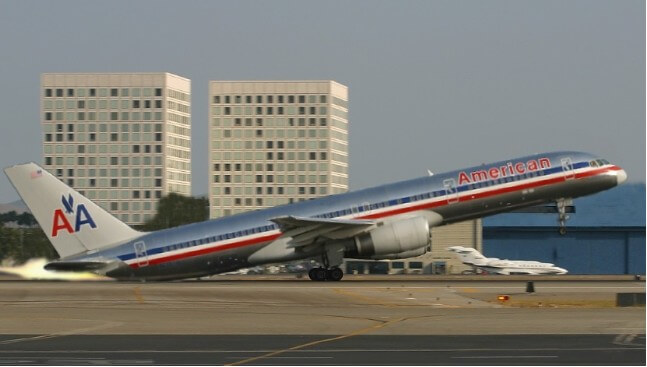
In this picture I can see an American Airlines Boeing taking off the aircraft was experiencing a tail strike at the moment the photo was taken.
The aircraft fuselage is silver with blue, white and red stripes along the fuselage. The American Airlines livery is printed on the fuselage. On the tail there is a red and blue AA. This is a twin engine wide- body aircraft.
In the background I can see two building, some trees, an aircraft hangar and a small jet. The sky is clear and the weather appears to be very good.
In the foreground I can see the ground and what appears to be a taxiway.
This can be caused by problems with the CG of the aircraft, early rotation and wrong speed input.
The consequences can be structural damage to the aircraft, They will need to return to the departure airport to check the aircraft and finally the aircraft might be grounded.
The procedures for a tail stike during takeoff are to continue the takeoff, climb to the minimum safety altitude without pressurizing the aircraft, follow the checklists and return to the airport to land.
I have never had this situation.
I have had this situation. (Explain)
How can a tail strike interfere with the flight safety?
A tail strike can interfere with the flight safety as it can cause structural damage that can lead to the aircraft not pressurizing correctly possibly resulting in a decompression.
Vocabulary Glossary
Aircraft Livery
An aircraft livery is a set of comprehensive insignia comprising color, graphic, and typographical identifiers which operators (airlines, governments, air forces and occasionally private and corporate owners) apply to their aircraft.
Wide-body
A wide-body aircraft is an airliner having a fuselage wide enough to accommodate two passenger aisles, also known as twin-aisle aircraft.