
 English

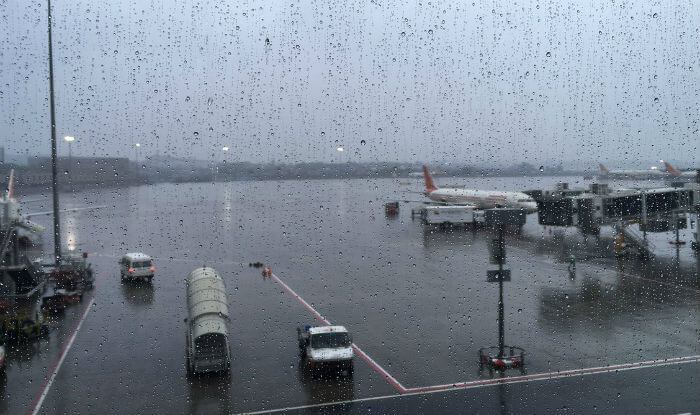
In this picture I can see a photo that seems to have been taken from inside a terminal building. The Apron seems to be wet which leads me to conclude that this airport has been hit by a rainstorm. I can also see droplets of water running down the glass window.
On the right side of the picture I can see an aircraft connected to the passenger bridge.
It looks like an Airbus A320 but it´s hard to tell as it is far away. There is also what looks like to be a catering truck near the aircraft.
On the left part of the photo I can see an airstairs truck with a polycarbonate cover and there are also two white airport vehicles. I can see white and red apron markings on the ground and in the background the lights have been turned on possibly due to poor visibility.
Just to conclude, during extremely heavy rainstorms, it literally eliminates tire braking capabilities or cornering abilities at high speeds so, probably, in this case, flight operations will temporarily be suspended until the weather improves.
In your opinion, how can bad weather conditions impact aircraft and airport operations?
Well, nowadays most commercial aircraft are certified to fly in “extreme weather condition”, which includes a mix of rain, wind, snow, and ice. In fact, the Federal Aviation Administration (FAA) has a long list of flight requirements for commercial aircraft, which manufacturers generally exceed. Many of the rules are designed to ensure that the planes can operate in wind and snow.
However, the airport may shut down or the airline may decide to ground a large number of flights for weather condition reasons which may lead to planes being grounded during winter storms, for example. Not to mention the flight delays and
cancellations.
What will happen next?
Supposing the weather improves, after, the flight attendants will finish embarking the passengers and seal the doors. Then, the pilots will request a push back truck and start the engines. At the same time, they will request taxi instructions and clearance for takeoff. Finally, they will put the aircraft in takeoff configuration for a wet runway and execute the procedures.
Now, I am going to read a statement to you and then you will have to tell me to what extent
you agree or disagree with it. 'Anomalies in terms of weather conditions are hard to detect as the weather is constantly changing.'
I disagree with this statement as there are in fact, ways to forecast the weather. The pilots can request information from the airport weather service for instance. In addition, the aircraft is also equipped with advanced weather radars that can provide specific information about weather conditions. And also, there are technologies being developed that will enable pilots to access different types of data or more detailed information for pre-flight and in-flight weather awareness such as the datalink weather system.
Vocabulary Glossary
Hit by Suffered, impacted by
Droplets Tiny water particles, very small drops of water
Cornering abilities The ability of the aircraft to turn to right or left
Braking capabilities The ability of the brakes to stop the aircraft